Product Overview
Industrial air pollution control systems are engineered to treat exhaust gases containing volatile organic compounds (VOCs), acid gases, and other airborne pollutants generated by industrial manufacturing processes. The appropriate treatment technology depends directly on gas composition, mass flow rate, pollutant concentration, operating conditions, and applicable environmental emission limits.
-
![Metal Ducting For Dust Collection]() Metal Ducting For Dust Collection
• Metal duct main body: straight pipe and connections• Material: galvanized steel, carbon steel, stainless steel• Wall thickness 0.7–2.0 mm• Flange or clamp connection with gasket/sealing ring• MOQ 1
-
![Dust Extraction Ducting Supplies]() Dust Extraction Ducting Supplies
• Modular design: straight pipe, elbow, tee, reducer, flange, clamp• Material: galvanized steel, carbon steel, stainless steel• Connection: flange or clamp• Custom elbow angle and bending radius• MOQ
-
![Chemical Resistant Exhaust Fans]() Chemical Resistant Exhaust Fans
• Impeller and casing material: PP / PVC / PVDF• For acid gas, alkali gas, or organic solvent waste gas• Centrifugal structure for higher pressure• Motor external to avoid corrosive gas contact• MOQ
-
![Industrial Fume Extraction Fans]() Industrial Fume Extraction Fans
• Centrifugal or axial structure• Centrifugal type for higher static pressure and duct resistance• Impeller material: carbon steel / stainless steel / PP• Motor external or rear-mounted for
-
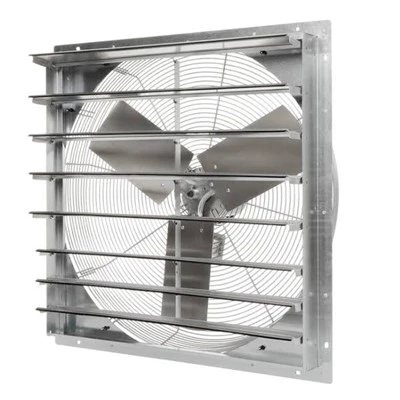
![Industrial Exhaust Fan With Shutter]() Industrial Exhaust Fan With Shutter
• Axial fan with automatic shutter• Shutter opens when fan runs, closes when fan stops• Square frame for wall or window mounting• Blade material: galvanized sheet / stainless steel / plastic• MOQ 1
-
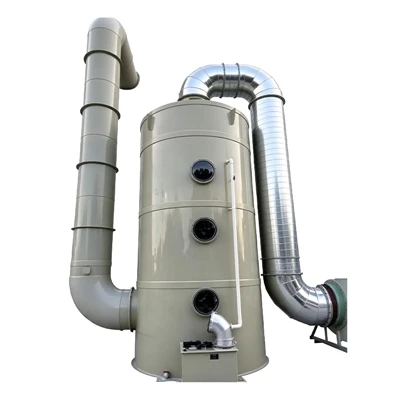
![Boiler Water Scrubber]() Boiler Water Scrubber
• Water film or spray washing for boiler flue gas• Treats dust and sulfur oxides in flue gas• Tower material carbon steel / stainless steel / PP• Optional alkali dosing system for SOx neutralization•
-
![Ammonia Wet Scrubber]() Ammonia Wet Scrubber
• Specifically for ammonia (NH₃) waste gas• Acid spray neutralization; sulfuric acid solution as absorption medium• Tower material PP or fiberglass; applicable temperature -10 to 120°C• Empty tower
-
![Wet Fume Scrubber]() Wet Fume Scrubber
• For water-soluble gas and odor removal• Washing medium: water / alkali / acid, selected by pollutant properties• Pressure loss 390–780 Pa; empty tower gas velocity 2.4–2.7 m/s• Liquid-gas ratio
-
![Activated Carbon Canister Filter]() Activated Carbon Canister Filter
• Cylindrical canister for continuous adsorption• Media: granular activated carbon / honeycomb activated carbon• Suitable for low-concentration organic solvent and odor removal• Inlet/outlet flange
-
![Industrial Scrubbers And Electrostatic Precipitators]() Industrial Scrubbers And Electrostatic Precipitators
• Two different principles: wet scrubbing and electrostatic precipitation• Scrubber for acid-base gas and dust-laden gas; ESP for high-temperature flue gas and high dust concentration• Scrubber
-
![Dust Collector Rotary Valve]() Dust Collector Rotary Valve
• Types: standard, pressure-resistant, high-temperature• Discharge capacity 2–16 L/r; standard speed 24 r/min• Working temperature: standard ≤80°C; high-temp ≤280°C; special ≤500°C• Flange: square (A
-
![Turbo Butterfly Valve]() Turbo Butterfly Valve
• Manual turbo or electric drive; turbo drive with self-locking• Body material Q235 carbon steel / 304 stainless steel• Leakage rate ≤3%; flange connection• Common sizes 200×160 to DN315• MOQ 1


Treatment Technologies and Selection Guide
|
Treatment Technology |
Primary Treatment Principle |
Key Selection Factors |
Information to Confirm |
|
Regenerative Thermal Oxidizer (RTO) |
Thermal oxidation of combustible pollutants and VOCs |
Gas flow rate, VOC concentration, inlet temperature, heat recovery configuration, and emission limits |
Required destruction efficiency, fuel consumption baseline, operating envelope, and safety requirements |
|
Regenerative Catalytic Oxidizer (RCO) |
Catalytic oxidation under specified operating conditions |
Gas composition, catalyst compatibility, inlet concentration, and operating temperature |
Catalyst type, potential catalyst poisons, replacement cycles, and performance guarantees |
|
Packed Bed Wet Scrubber |
Gas-liquid contact for soluble or reactive pollutant removal |
Pollutant solubility, gas flow, liquid circulation rate, pressure drop, and corrosion conditions |
Removal targets, scrubbing liquid requirements, material compatibility, and wastewater handling |
|
Activated Carbon Adsorption System |
Adsorption of target compounds onto activated carbon media |
Pollutant characteristics, concentration, humidity, flow rate, and adsorption capacity |
Carbon type, breakthrough criteria, replacement or regeneration methods, and spent-carbon handling |
|
Rotary Concentrator with Oxidation |
Adsorption and concentration prior to downstream oxidation |
Exhaust flow, pollutant concentration, humidity, and concentration ratio |
Adsorbent compatibility, operating limits, downstream oxidizer sizing, and system-level performance |
Technical Specifications and Operating Conditions
|
Technical Parameter |
Specification / Design Requirement |
Verification Basis |
|
Exhaust Gas Flow Rate |
Project-specific design flow, including operating variations |
Process data sheet and agreed design basis |
|
Pollutant Composition |
Identified compounds with min/avg/max concentrations |
Process information and representative gas analysis |
|
Inlet Gas Temperature |
Normal operating range and expected temperature fluctuations |
Process operating data and thermal profile |
|
Destruction / Removal Target |
Required outlet concentration and destruction efficiency (DRE >= 99%) |
Applicable permit limits and performance guarantees |
|
System Pressure Drop |
Allowable pressure drop across equipment boundary |
Engineering calculations and flow test conditions |
|
Material Compatibility |
Materials resistant to gas composition, condensate, and scrubbers |
Comprehensive material selection review |
|
Utility Requirements |
Electrical supply, fuel, compressed air, and process water |
Equipment configuration and utility balance |
|
Control & Instrumentation |
Sensors, alarms, interlocks, and PLC automation functions |
Process control philosophy and safety review |
Applications and Process Conditions
|
Industry Sector |
Potential Exhaust Characteristics |
Initial Treatment Considerations |
|
Chemical & Petrochemical Processing |
VOCs, solvent vapors, potentially corrosive compounds |
Evaluate gas composition, flammability, concentration spikes, and material compatibility prior to oxidation or scrubbing selection. |
|
Automotive & Industrial Coating |
Solvent-laden exhaust from coating and drying booths |
Assess airflow volume, solvent load, operating schedules, heat recovery needs, and the viability of pre-concentration stages. |
|
Metal Surface Treatment & Pickling |
Acidic gases, aerosols, and process-specific mists |
Determine gas-liquid contact requirements, corrosion resistance, mist separation efficiency, and wastewater neutralization. |
|
Semiconductor & Electronics Manufacturing |
Fluorinated compounds (CF4, SF6) and acid fumes |
Identify specific chemical compounds, reaction products, exhaust chemistry, safety interlocks, and local emission limits. |
|
Pharmaceutical & Fine Chemical Production |
Solvent vapors and mixed process emissions |
Assess solvent profiles, concentration variance, solvent recovery potential, material compatibility, and downstream abatement. |
Manufacturing and Quality Control
Manufacturing standards are strictly governed by selected equipment designs, metallurgical requirements, and project specifications.

Fabrication and Assembly
Dimensional tolerances for components and assemblies are maintained according to part geometry, material thickness, fabrication methods, and approved engineering drawings. Requirements for pressure-retaining vessels are established in accordance with applicable structural codes and project scope, maintaining a clear distinction between pressure vessels, ductwork, and non-pressure housings.

Welding and Inspection
All welding procedures, welder qualifications, and inspection protocols adhere strictly to governing codes and project specifications. Depending on the equipment class, quality plans incorporate visual examination, dimensional checks, liquid penetrant testing (PT), radiographic testing (RT), and ultrasonic testing (UT) on critical pressure boundaries.

Surface Preparation and Protective Coatings
Surface treatment and coating specifications are matched to operating temperatures, exposure environments, and condensate chemistry. Carbon steel substrates undergo abrasive blasting to high-cleanliness standards, followed by multi-coat applications of high-temperature inorganic zinc silicates or specialized corrosion-resistant barriers.
Engineering Customization
Industrial air pollution control systems require customized engineering around facility layout constraints, seismic load ratings, and hazardous area classifications (e.g., ATEX or NEC Div. 1/2).
Technical FAQ

Request a Technical Proposal and Quotation
Submit your process data sheet (PDS), exhaust gas analysis, and local emission requirements directly to our engineering team. Our applications engineers review all submissions to deliver preliminary mass balance calculations, sizing schematics, and technical feedback within 24 business hours.a
As one of the most professional waste gas treatment equipment manufacturers and suppliers in China, we're featured by quality products and good service. Welcome to wholesale durable waste gas treatment equipment in stock here and get pricelist from our factory. We also accept customized orders.
Injection molding exhaust gas purifier, VOC Activated Carbon Purification Box, Waste Gas Purification Equipment